
Monday, 19 February 2018
28th February 2018 Meeting - Monster Bulbs
Our meeting for 28th February 2018 is the Monster Bulb Auction. Please feel free to come along and join us.



Sunday, 11 February 2018
Growing Lachenalia
GROWING LACHENALIA
I decided to concentrate on growing lachenalia as they are very suited to pot culture and don’t grow very big – okay for my small back yard. They are happy growing close together and look best that way. Most species come from the West Cape area in South Africa, which has cool, damp winters and dry summers. As we can have summer down-pours it is therefore best to put pots under cover after the leaves have died down, and before Christmas. The pots can be retrieved in autumn, and the few early flowering ones before the rest, as they may start to make roots and shoot, even when the soil is dry. Give one good watering, and then not another until shoots appear. As the weather can still be quite warm in autumn, the pots are probably best in semi-shade.
Only a few species are available here as bulbs: aloides forms, particularly quadricolor (yellow & red), bulbifera (red), mutabilis (best forms with two or more colours on stalk), and contaminata (white) and maybe viridiflora (turquoise blue). A couple of specialist bulb growers may offer a few other species. So to build a collection means obtaining imported seed, and nearly all available species are on the quarantine allowed ‘seeds for sowing’ list. Seed takes at least two years to flowering stage: I have found three years, so as Fermi de Sousa said, once you start sowing some seed each year, then you begin having a succession of flowers to look forward to. This last year I had glaucina (syn. orchioides var glaucina), mathewsii and thomasiae flower for the first time. They were respectively blue, yellow and white.
Seed generally germinates well, but in the first season one only gets small grass-like stems which don’t grow very big. It’s probably best to keep the little plants growing as long as possible, by giving some weak liquid fertiliser (high in potassium) and moving the pots to semi-shade when the weather warms up. The little bulbs that form are so small that it is best to keep them in the same container for the next season as well. This means selecting the compost carefully.
Lachenalias come from poor soil areas, so no rich compost is advisable. I mix up commercially available bulb, bonsai and cactus & succulent composts, which are sterile, and therefore no weeds should appear. They are free draining. Topping with a thin layer of sand helps to keep the moisture in and allows one to see the emerging seedlings easily. As the seed is quite small, I put it on a white saucer and slide off seeds to the tamped down compost surface with a finger, just to get the seed evenly spread. The pots need to be kept moist, and having a layer of sand means watering from the top is okay, otherwise, water from the bottom. Sow seed from about mid March until May.
Someone alerted me to the use of aspirin water with plants: 1½ soluble aspirin to 4½ litres of water, with a little mild liquid soap so that spray sticks to plant surfaces. Aspirin contains salicylic acid, which stimulates plants’ natural immune system to pests and diseases. As lachenalia can be attacked by virus, spraying with aspirin water may well help. Watering with aspirin water has also said to have markedly improved germination of seed. Worth a try.
Obtaining suitable pots for flowering size bulbs may not be easy. There are squat terracotta pots about 18 cm wide readily available, but they are much heavier than plastic and dry out more quickly. Sometimes it is possible to scrounge a few similar plastic pots where nurseries have recycling bins: I go to CERES in East Brunswick and Bulleen Art and Garden. I have been lucky enough to get smart terracotta lookalike pots at a stand at the Melbourne International Flower and Garden Show. It is usually located in the far Rathdowne St side stands – sells gardening clothes etc.
Geoff Crowhurst
Lachenalia Mathewsii

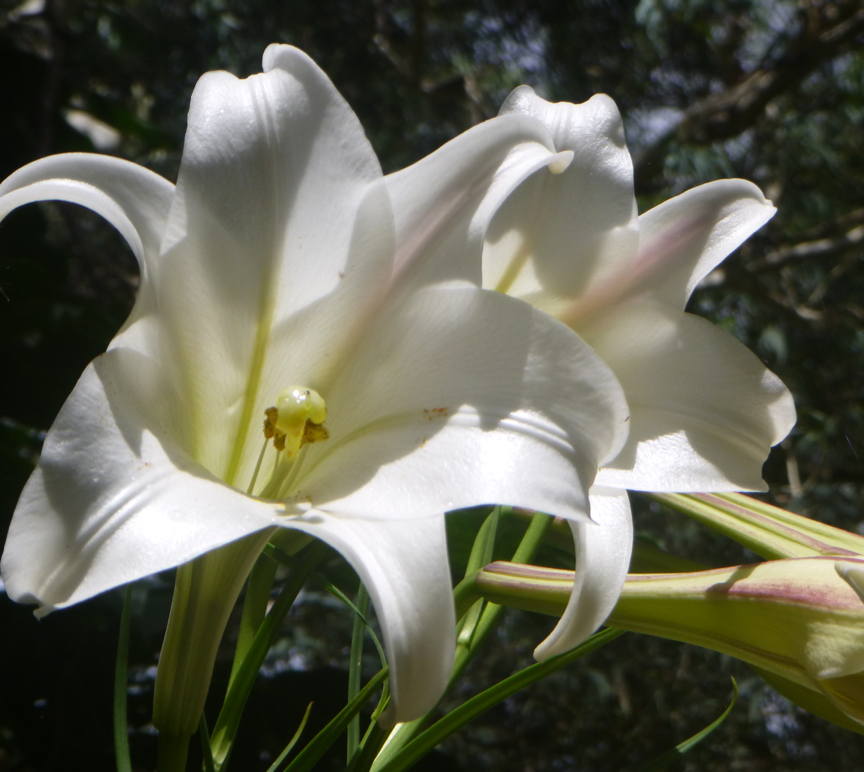
True Belladonna
A true belladonna’s flowers always face in one direction while the brunsvigia hybrids form a circle.

Tuesday, 6 February 2018
Flowering Now...
A collection
from Bruce, another expert grower in the society...
Brunsvigia josephinae
 |
Eucomis zambesiaca
 |
Crinum pedunculatum
 |
Eucomis bicolor
 |
Griffinia espiritensis
 |
Griffinia liboniana
 |
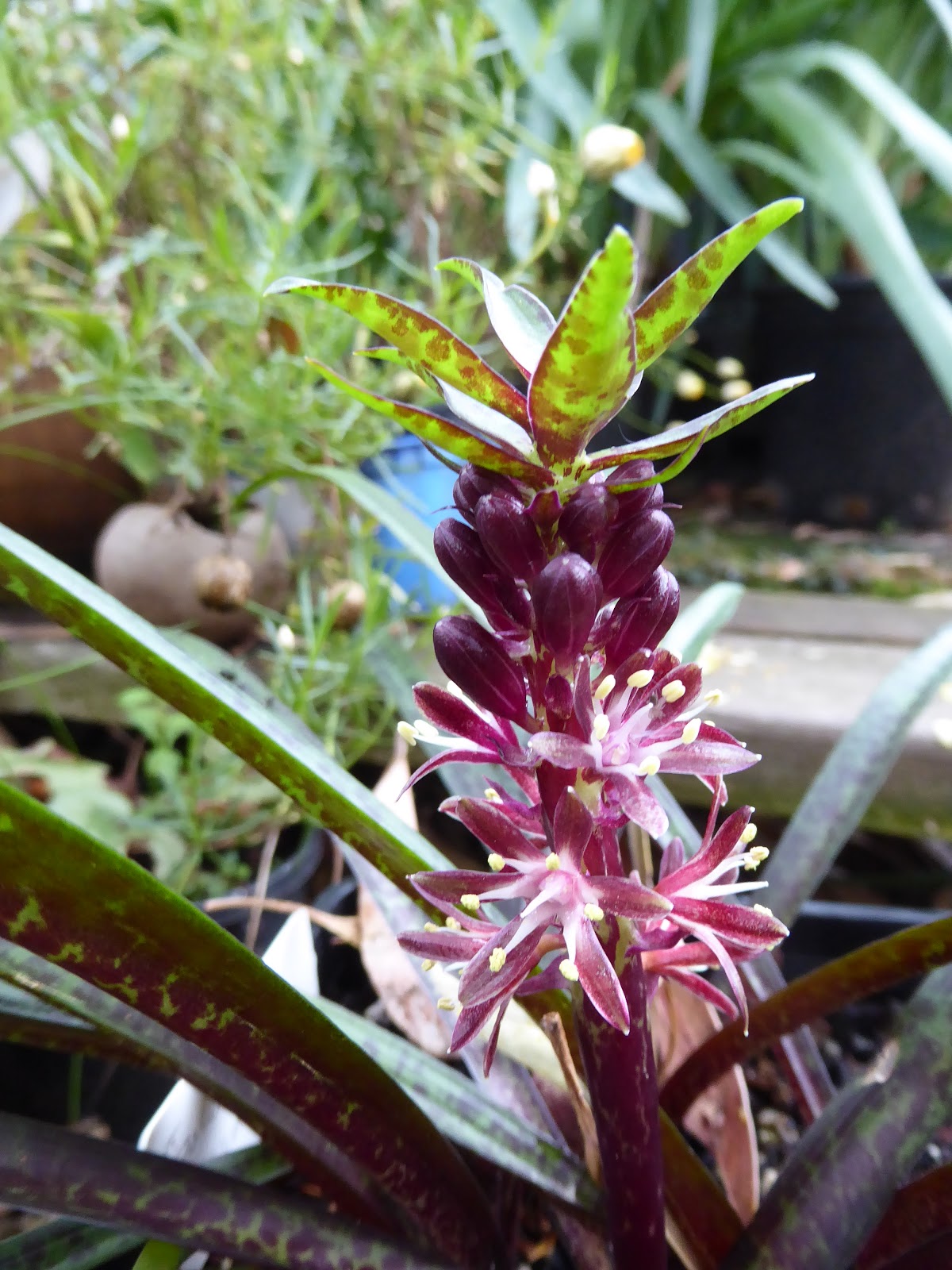
Eucomis vandermerwei
 |
Scadoxus pseudocaulus
 |
Haemanthus carneus
 |
Haemanthus humilis Quanti form
 |
Crinum moorei pink
 |
Sunday, 4 February 2018

Saturday, 3 February 2018
Flowering Now...
Here are some beautiful photos of what is flowering now provided by George....one of our expert Gardeners!
 |
 |
 |
 |
 |
 |
 |
 |
 |
 |
 |
 |
 |
 |
 |
 |
 |
Tuesday, 30 January 2018


Monday, 14 August 2017
Iris tuberosa
By Joy Quinn
 |
| Iris tuberosa |
Another winter flowering iris in the reticulata family
Plant them deeply 8cm or so, in pots or in
the garden in autumn. They will need
time to establish before blooming begins so you need to be patient. They grow best in
warm sun to partial shade in a sheltered spot. Wind protection is needed as although the spikes are only
about 25cm tall they are fragile and bend easily.
The mature tubers look like dried little fingers. The foliage is grass like and the flower spikes appear later and are usually shorter.
They are an ideal rockery plant given wind protection and, given time to establish, will increase in number.
The mature tubers look like dried little fingers. The foliage is grass like and the flower spikes appear later and are usually shorter.
They are an ideal rockery plant given wind protection and, given time to establish, will increase in number.

Sunday, 13 August 2017
Miniature iris
Article and photos by David Glenn from Lambley
The Victorian Bulb Society wishes to thank David Glenn from Lambley Nursery & Gardens for kindly providing the this article and photos for our website.
Two of the most beautiful winter flowering bulbous Iris are, fortunately, two of the easiest to grow.
Iris ‘Harmony’ is a hybrid between Iris histrioides, from a small area in north central Turkey and the more widespread Iris reticulata, a native of the Caucasus, northern and eastern Turkey, north eastern Iraq and Iran.
 |
| Iris reticulata 'Harmony' |
‘Harmony’ has sapphire blue standards and royal blue falls. White stripes surround a thin raised yellow ridge on the falls. The flowers, held on 15cm tall stems, have a delicate primrose fragrance.
 |
| Iris reticulata 'Alida' |
Iris ‘Alida’ is a pale sport of ‘Harmony’ and just as good a doer in the garden. It has pale grey-violet flowers and blue grey falls. It too has the delicious primrose fragrance.
In my garden these jewels of the bulb world grow in a hot dry garden bed with small dry climate rock garden plants. This bed is watered only once or twice a year, just enough to keep the dwarf shrubs and perennials alive. The Iris themselves need no summer water at all. As my soil is naturally very acid I add a good dusting of ground limestone to the soil before planting.
The bulbs increase prolifically and where I planted single bulbs a few years ago there are now up to twenty flowering sized bulbs in each clump.
The bulbs increase prolifically and where I planted single bulbs a few years ago there are now up to twenty flowering sized bulbs in each clump.
 |
| Iris reticulata 'George' |
Iris ‘George’ is another hybrid from the same parentage with rich purple flowers. It is a bit taller and is just as vigorous. During the dull grey days of winter the colour can look a bit leaden but given a glimmer of sunshine it sparkles.
 |
| Iris histrioides 'Lady Beatrix Stanley’ |
Iris histrioides grows wild in a small area in Amasya Province which, although close to the Black Sea has hot dry summers and cold winters due to its altitude. ‘Lady Beatrix Stanley’ is the only form of Iris histrioides I grow. The soft mauve grey flowers have an indescribable luminescence and the intricate spotting on the falls adds to its beauty. It is a little slow to build up but otherwise holds no terrors.
 |
| Iris reticulata 'Cantab' |
I grow about a dozen forms of Iris reticulata from the rather thin textured white of ‘Natasha’ to the dark ‘Purple Gem’ and the soft blue ‘Cantab’. All do well in my garden as long as their few wants are taken care of. They are planted 12-15 cm deep in well drained soil which is given minimal summer supplementary irrigation.
 |
| Iris reticulata 'Natascha' |
Whilst these Iris do well in pots for a season or so they are difficult to keep happy if grown this way in the long term. I do dig the occasional clump in when it’s in bud, put it in a pot and enjoy it inside the house for a week or so before planting it back in the garden. Sometimes I’ll split and replant congested clumps soon after flowering.
 |
| Iris reticulata 'Purple Gem' |
Monday, 3 July 2017
Local knowledge
 |
| Crocus tommasinianus "Yalta" |
Nothing beats local knowledge for growing your bulbs and plants. Quite often you will read that a bulb likes a "summer baking" yet the summers here in Melbourne, Victoria are quite different to other parts of the world (more like summer roasting). You can find out the hard way through trial and error or make life easier for yourself (and save your bulbs in the process) by learning from local growers and gardeners.
Our society has members growing a large variety of bulbs, corms (like the Crocus above), rhizomes and tubers. If you come along to one of our meetings you could learn more about the best growing conditions for this part of the world, either from one of our local speakers or through talking to our members over a cuppa and a piece of cake during supper. And who knows, you could teach us a thing or two about your bulb growing experience!
Our meetings are held on the 4th Wednesday of each month (2nd Wednesday in December).
Friday, 16 June 2017
Plant liliums now
 |
| OT lilium |
Summer may seem like a long way off but June is the time to
start preparing for your summer display of liliums.
The photo above is a lilium (Conca d’Or) that Adrian entered in the Ferny Creek Horticultural Society summer show. This stunning OT lilium won a blue ribbon and is listed in his current catalogue.
Thursday, 8 June 2017
Our bulb society
 |
| Geissorhiza radians |
Welcome to the Victorian Bulb Society. We meet monthly in Vermont (Melbourne, Australia) to learn about bulbs, purchase plants and show off our flowers on the show bench. Our society started in July 2014. This is our blog where we post interesting information and show photos from our meetings Click on the "When & Where" tab above to find out more about our meetings or the "About Us" tab for information about our society.
Subscribe to:
Posts (Atom)